
Competitor pricing is useful context. It is not a strategy, and matching it hands your margin to whoever is most desperate.
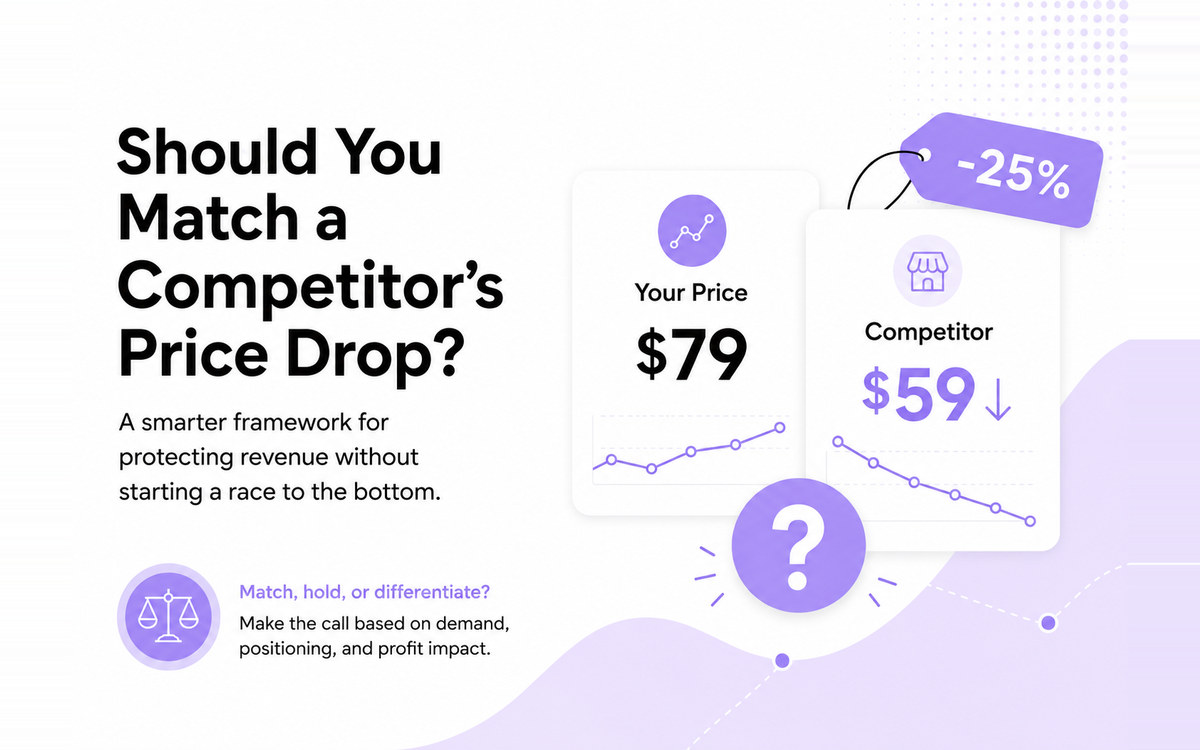
In competitive markets, pricing pressure is everywhere.
A food tour sees another food tour drop prices. A walking tour notices a similar product running a promotion. A sightseeing operator sees competitors discounting on an OTA.
The reaction is almost automatic:
"We need to stay competitive."
So the operator lowers the price too.
Sometimes that is the right move.
But many times, it is not.
Competitor pricing is useful context. It is not a strategy.
The biggest mistake operators make with competitor pricing is assuming that a competitor's price reflects the market.
It may not. That is where AI-driven revenue management can help: by grounding pricing decisions in your own demand signals — booking pace, lead time, availability, cancellations, and historical patterns — before reacting to what a competitor is doing.
A competitor may be discounting because their reviews are weaker. Their product may be buried lower on an OTA. Their photos may underperform. Their availability may be harder to understand. Their start time may be less convenient. They may have more capacity to fill.
Or they may simply be reacting out of fear.
If your own demand is healthy, matching that discount may be unnecessary.
Worse, it may reduce revenue without increasing bookings.
This is why "being competitive" can become dangerous.
Operators sometimes use the phrase to justify price changes without first asking whether their own demand has changed.
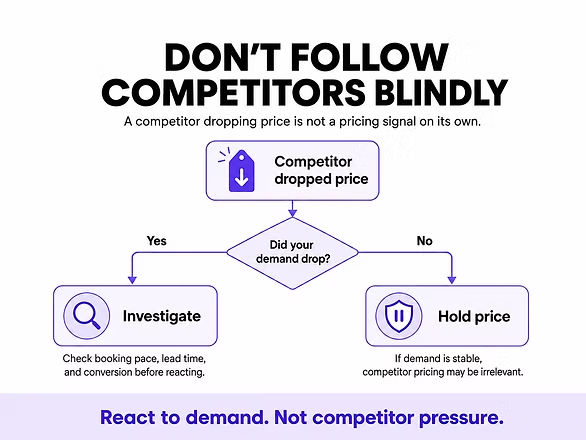
A competitor's price drop should trigger analysis, not automatic action.
Online travel agencies make comparison easy.
That is part of their value to travelers. Customers can see similar products side by side, compare reviews, compare availability, and compare price in seconds.
For operators, that visibility can create pressure.
When products appear next to each other, price becomes very visible. But visible does not mean decisive.
Travelers do not only compare price. They compare trust, timing, reviews, cancellation policies, photos, product descriptions, availability, and how confident they feel in the choice.
This is especially important in tours and activities because the product is often experiential and emotionally driven. A traveler choosing a once-in-a-lifetime activity may not simply pick the cheapest option.
They may pick the one that feels safest, easiest, best reviewed, or most aligned with the trip they imagined.
That does not mean operators can ignore price. It means they should avoid treating price as the only variable.
Price matching feels safe because it reduces anxiety.
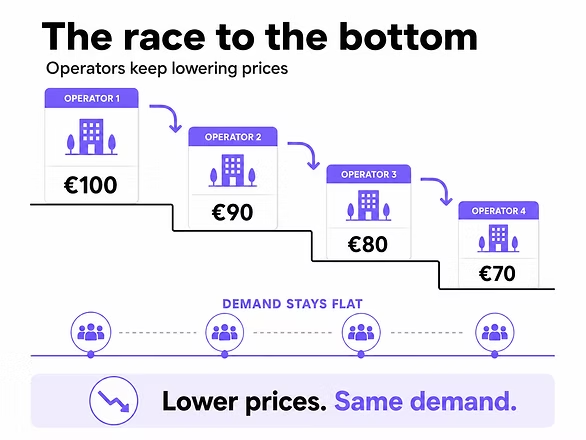
If a competitor drops to €80 and you stay at €100, it feels like you are taking a risk.
But lowering price creates its own risk.
If customers were already booking at €100, dropping to €80 means giving up €20 per guest. To justify that decision, the lower price needs to create enough additional demand to offset the revenue loss.
Many operators do not run that calculation.
They simply see a competitor discount and react.
That creates the conditions for a price war.
Research on price matching and product differentiation published in the Journal of Retailing and Consumer Services also shows that price matching is not automatically beneficial. The study notes that while price matching can help retailers respond to lower-priced competitors, it can also harm margins and intensify price competition depending on the market context.
For tour operators, the lesson is similar: matching a competitor's price should be a strategic decision, not an automatic reaction.
One operator discounts because they need to.
Another operator matches because they feel pressure.
A third follows because they do not want to be left behind.
Soon, the whole market is cheaper.
But demand may not have changed.
Aloja was built around this exact principle: pricing should respond to real demand signals, not competitor pressure. By looking at booking pace, booking windows, cancellations, historical patterns, and market context together, operators can make pricing decisions with more confidence and less guesswork.
For most operators, it is almost impossible to evaluate all of these real-time signals manually across every product, date, and channel. That is exactly the problem Aloja was built to solve.
There are times when competitor pricing matters.
If your bookings slow down after competitors lower their prices, that is a signal worth investigating.
If your conversion rate drops while traffic remains steady, price may be part of the issue.
If similar products with similar reviews, availability, distribution, and positioning are consistently winning demand at a different price point, the market may be telling you something.
But the key is to connect competitor pricing to your own performance.
Do not ask only, "What are they charging?"
Ask:
"Did our demand change?"
"Did our conversion change?"
"Are we behind pace?"
"Are we losing visibility?"
"Are they truly comparable to us?"
"Is price the reason customers are choosing them, or is something else happening?"
This is where pricing becomes strategic.
Competitor pricing should be one input, not the decision-maker.
A better pricing strategy starts with three signals.
The first signal is your own booking pace.
Are bookings coming in faster or slower than expected?
The second signal is your conversion performance.
Are people viewing the product but not booking?
The third signal is your positioning.
Are you competing against truly similar products, or are you comparing yourself to operators with different quality, reviews, inclusions, availability, or distribution?
Once operators understand those signals, they can make better pricing decisions.
If demand is strong, hold price or increase it.
If demand is weak and price appears to be the issue, stimulate demand.
If competitors drop prices but your demand stays healthy, do not follow them down.
That discipline matters.
This is the pricing philosophy behind Aloja: pricing should respond to demand signals like bookings, booking pace, booking windows, cancellations, similar products, holidays, and close dates — not just competitor pressure or static assumptions.
Dynamic pricing does not mean blindly copying competitors.
Good dynamic pricing considers competitor prices, but it should not treat them as the only signal.
A competitor's price is external context.
Your own demand is the foundation.
The strongest pricing decisions combine internal signals, such as bookings and pace, with external signals, such as competitor pricing and market conditions.
That is the difference between reactive discounting and revenue management.
Reactive pricing says, "They dropped, so we drop." Revenue management asks: "What is demand doing?" and "What price is most likely to maximize revenue?"
The goal is not to ignore competitors. The goal is to understand when their prices actually matter. A competitor discount should not automatically pull your price down. It should prompt a better question: is your own demand telling you to react?
Not automatically. Operators should first check whether their own demand, booking pace, or conversion has changed. If demand remains strong, matching a competitor discount may reduce revenue unnecessarily.
Yes. Competitor pricing is useful context, but it should be combined with internal demand signals such as bookings, booking pace, conversion, and performance versus expectations.
Operators can avoid price wars by reacting to demand rather than competitor panic, measuring revenue instead of occupancy, and understanding whether competitors are truly comparable.
Aloja helps tour and activity operators analyze booking pace, booking windows, cancellations, historical data, and demand patterns, so pricing decisions are based on real performance rather than pressure. Instead of manually checking every product, date, and channel, operators can use Aloja to support smarter pricing decisions with more consistency.
What we're seeing across live accounts, and the questions operators keep asking. No product announcements.