
The Last-Minute Discount Trap: Why Empty Seats Don’t Always Mean Lower Prices
- MJ Lopez
- 2 days ago
- 5 min read

Every tour operator knows the feeling.
The departure is tomorrow. The guide is scheduled. The vehicle is ready. The experience is happening either way.
But there are still empty seats.
The natural reaction is to discount.
That instinct makes sense. Tours and activities sell perishable inventory. Once a departure happens, any unsold spot is gone forever. You cannot sell yesterday’s empty seat tomorrow.
So the logic feels obvious: if the tour is not full, lower the price and try to capture a few more bookings.
The problem is that this logic starts from the operator’s needs, not the traveler’s behavior. And that is where last-minute discounts can become expensive.
This is exactly where a revenue management approach becomes useful. Aloja helps operators look beyond empty seats and understand whether a price change is likely to improve revenue, not just occupancy. Built by a team with deep experience in tours, activities, and travel technology, Aloja focuses specifically on helping operators make smarter revenue management decisions in situations like this.
For tour operators, a last-minute discount is a price reduction offered close to departure to stimulate bookings for remaining seats.
Last-minute bookers are not always looking for deals
A traveler booking close to departure is often already in the destination. They may be walking through the city, checking their phone, coordinating with family, or trying to decide what to do that afternoon.
At that moment, they are often optimizing for convenience.
They want something available. They want the timing to work. They want the meeting point to be easy. They want confidence that the experience will be good.
Price still matters, of course. But it may not be the main reason they book.
Arival research cited in its article “3 Things Operators Get Wrong About Dynamic Pricing” shows that last-minute bookings are not always driven by price. Among travelers booking attraction tickets within three days, the top reason was flexibility at 41%, while only 15% said they booked late because they found better deals. By contrast, among travelers booking at least three days in advance, 33% cited better pricing and 32% cited availability concerns. For operators, the takeaway is clear: a last-minute customer may care more about timing, convenience, availability, and confidence than a discount.
A secondary perspective from a LinkedIn article on the psychology behind last-minute bookings by CouponzGuru.com points in the same direction: late travel decisions are often shaped by immediacy, flexibility, convenience, and confidence, not only price. For operators, that reinforces the idea that a last-minute customer may still convert without a discount if the experience feels easy, available, and trustworthy.
That means earlier bookers are often more responsive to pricing and availability signals.
Late bookers behave differently.
They may still respond to a deal, but they are often working within a smaller set of options and a more urgent decision.

The hidden cost of discounting late
The biggest risk with last-minute discounts is not that no one books.
The risk is that people do book — but many of them would have booked anyway.
If a customer was already willing to pay full price and receives a 20% discount, the operator did not create new demand. The operator simply collected less revenue from existing demand.
This is why discounts can be misleading.
They make the tour look healthier because occupancy goes up. More people show up. The departure feels better. The team may feel like the discount worked.
But revenue may tell a different story.
Imagine a tour priced at €100 per person.
If 10 people book at full price, revenue is €1,000.
If the operator discounts to €80 and gets 12 bookings, revenue is €960.
The tour is fuller, but the business made less money.
This is the trap.
A full tour is not always a successful tour.
A fuller tour at the wrong price may simply be a lower-margin tour.
Aloja is built around this distinction: more bookings are only valuable when they lead to better revenue outcomes. By looking at booking pace, lead time, availability, cancellations, and historical patterns together, operators can make pricing decisions with more context.
Discounting should be measured by revenue, not occupancy
Many operators measure the success of a discount by how many extra bookings it generates.
That is only half the equation.
The better question is:
Did the additional demand offset the revenue given up through the discount?
If the answer is yes, the discount may have worked.
If the answer is no, the discount created activity but not value.
This distinction matters because operators often feel pressure to fill departures. Empty seats feel like failure. But revenue management is not about emotional comfort. It is about improving financial outcomes.
The right metric is not just occupancy.
Operators should also look at revenue per departure, average ticket price, revenue per available seat, and margin per guest.

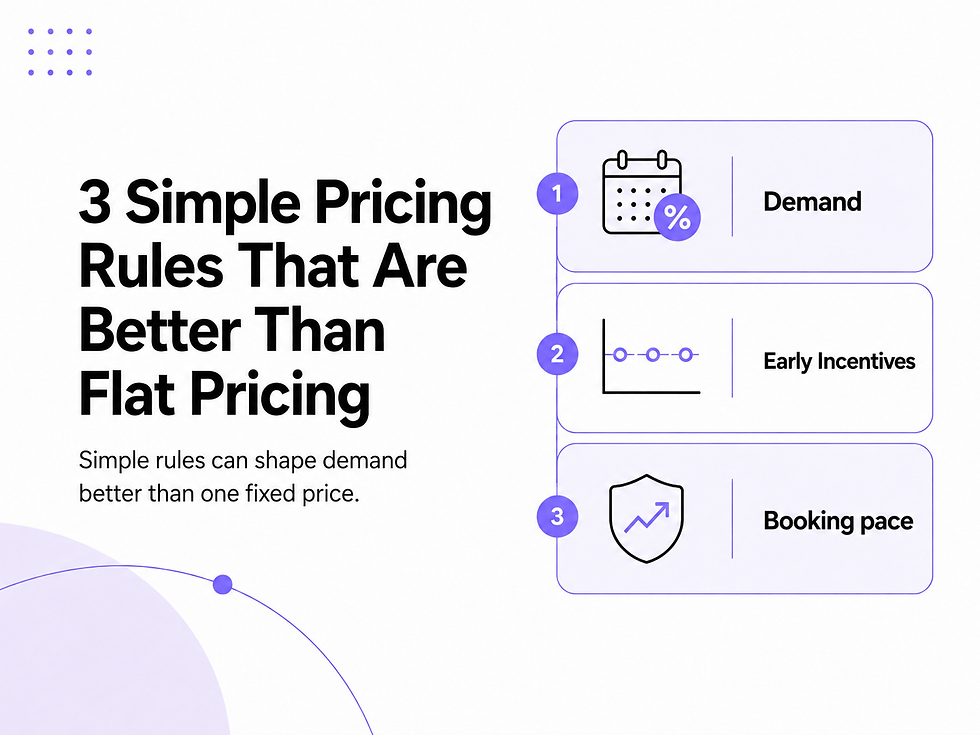
The better time to influence demand
If the goal is to use pricing to influence demand, operators should not wait until the final hours before departure.
At that point, the audience is smaller. Many travelers have already booked something else. Others are optimizing for convenience, not price.
Pricing often has more leverage earlier in the booking window.
Earlier bookers are still comparing options. They are planning their itinerary. They are deciding which experiences matter. They may be more open to price incentives, availability messaging, or early-booking offers.
That does not mean every operator should run permanent early-bird discounts.
It means operators should think about timing.
If demand is weak, it may be better to stimulate bookings earlier, while there is still a larger pool of travelers making decisions.
If demand is strong, it may be better to protect price closer to departure, when remaining availability becomes more valuable.
This is the opposite of how many operators behave.
They hold price early, wait until pressure builds, then discount late.
A better approach is to use pricing earlier to shape demand and protect revenue later when urgency is higher.
When last-minute discounts can make sense
None of this means last-minute discounts are always wrong.
They can make sense when demand is clearly weak, when the product has excess capacity, when the operator can target the discount without cannibalizing full-price demand, or when the promotion is part of a deliberate channel strategy.
The key word is deliberate.
Discounting because a departure looks empty is reactive.
Discounting because the expected revenue outcome is better is strategic.
The same principle applies to competitor pricing. As we discuss in our article on why operators should stop matching competitor prices, a price change should be based on demand signals, not pressure from what another operator is doing.
Operators should avoid blanket last-minute discounts and instead ask whether the price change is likely to create incremental demand.
If not, the discount may simply reward customers who were already going to book.
For operators managing multiple products, departures, and booking windows, this is difficult to judge manually. This is also part of the hidden cost of manual pricing: the issue is not that operators lack judgment, but that it is almost impossible to monitor every departure, booking window, cancellation, and demand shift by hand.
FAQs
Are last-minute discounts bad for tour operators?
Not always. Last-minute discounts can help in specific cases, but they often reduce revenue if they mostly discount customers who would have booked anyway.
What should tour operators measure when discounting?
Operators should measure revenue per departure, average ticket price, revenue per available seat, margin per guest, and whether the discount created incremental demand.
How can Aloja help operators avoid unnecessary last-minute discounts?
Aloja helps tour and activity operators understand whether a departure is genuinely behind demand or simply has seats left. By monitoring booking pace, lead time, availability, cancellations, and historical patterns, Aloja supports pricing decisions that are based on revenue opportunity rather than last-minute pressure.


Comments