
5 Pricing Mistakes Operators Make (and How to Fix Them)
- MJ Lopez

- Jul 3
- 6 min read
Pricing is one of the most important revenue levers for tour and activity operators. It affects conversion rates, occupancy, distribution performance, customer perception, and long-term profitability.
But most tour pricing mistakes do not happen because operators are careless. They happen because operators react to surface-level signals that feel logical in the moment.
A tour has empty seats, so the price gets lowered. A competitor drops their rate, so the operator matches it.
A departure sells out, so the business assumes the pricing strategy worked.
In reality, those signals can be incomplete or misleading.
Tour and activity pricing is especially difficult because inventory is perishable. Once a boat departs, a guide starts the tour, or a time slot passes, any unsold seat is gone forever. That pressure often leads operators to make reactive pricing decisions instead of revenue-driven ones.
Here are five common tour pricing mistakes operators make, and what to focus on instead.
1. Measuring Success by Occupancy Instead of Revenue
A full tour feels like a win.
Guides are busy, vehicles are full, and the operation looks successful. But a full tour does not always mean a profitable tour.
If a departure fills because the price was too low, the operator may have left revenue on the table. More guests can sometimes mean more work, higher variable costs, and lower margins.

Operator B generated more revenue with fewer guests.
That does not mean occupancy is unimportant. Empty seats still matter. But occupancy should not be the only metric used to judge pricing performance.
Instead of asking, “Did we fill the tour?” operators should ask:
Did we generate the highest possible revenue from the demand available?
That shift changes the pricing conversation from filling seats at any cost to maximizing revenue per departure.
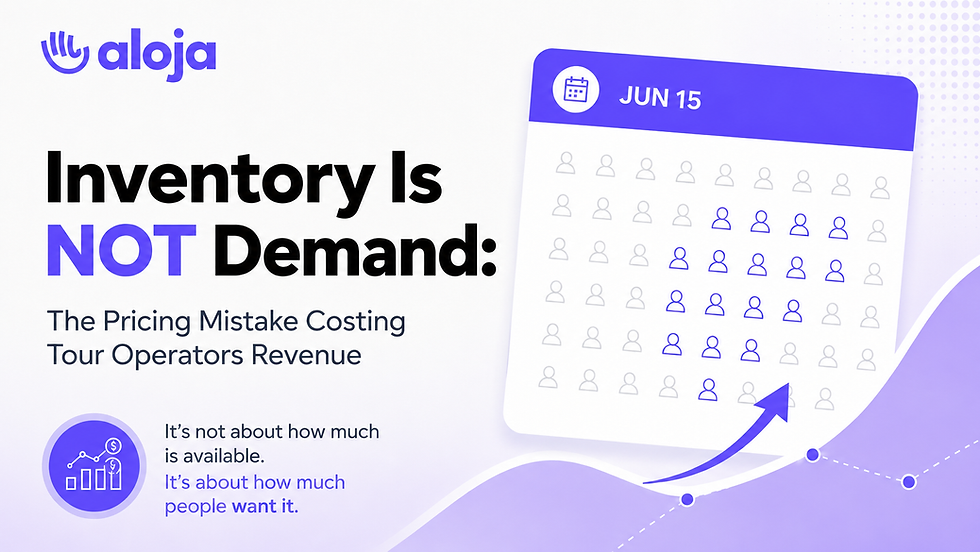
2. Confusing Static Inventory with Active Demand
One of the most common pricing mistakes in tours and activities is treating inventory and demand as the same thing.
They are not.
Inventory is the number of seats left on a departure.Demand is the speed at which customers are booking those seats.
Imagine two departures. Both have 25 out of 50 seats remaining. On paper, they look identical.
But Tour A has not received a booking in four days, while Tour B is receiving three bookings per day.
Same inventory. Completely different demand.
Those two departures should not be priced the same way.
A similar principle exists in inventory management more broadly. Research shared by Zaragoza Logistics Center notes that inventory policies can become outdated when demand patterns change, and that dynamic management helps businesses better balance responsiveness with financial performance. For tour operators, the same idea applies: available seats only tell part of the story if pricing does not also account for how demand is moving.
To understand real demand, operators need to look beyond available seats and evaluate booking pace:
How far away is the departure date?How fast does this product usually sell?Is this date ahead of or behind its historical booking curve?Are bookings accelerating, slowing down, or stalling?
Reacting only to available spaces can lead operators to discount too early when demand is healthy, or wait too long when bookings are genuinely slowing.
A better pricing strategy looks at how inventory is moving, not just how much inventory is left.
3. Pulling the Last-Minute Discount Trigger
Because tour inventory is perishable, last-minute discounts feel logical.
If a departure has empty seats close to the start time, lowering the price seems like a quick way to recover revenue.
But last-minute discounting often comes with a hidden cost.
Many travelers booking within 24 to 48 hours are already in the destination. They may be looking for convenience, availability, timing, location, weather-friendly activities, or something that fits their plans. They are not always searching for the lowest price.
When operators discount too close to departure, they may not create much new demand. Instead, they may give a lower price to customers who were already willing to book at the original rate.
The better question is not:
Do we still have empty seats?
It is:
Will this discount create enough additional bookings to increase total revenue?
Often, the better opportunity is earlier in the booking window, when travelers are still comparing options and planning their itinerary. Early incentives can help bring demand forward. Last-minute discounts, on the other hand, can become a panic button that reduces revenue without solving the real problem.
4. Copying Competitor Prices Blindly
Competitor pricing is useful context. It can help operators understand market positioning, seasonal shifts, promotional activity, and local pricing trends.
But competitor prices should not dictate your pricing strategy.
As Prisync explains in its overview of price matching, matching competitors can support customer confidence in some cases, but it can also reduce margins and contribute to price wars when businesses react without a clear strategy.
A competitor may lower prices for many reasons that have nothing to do with your business:
They may be behind on booking pace.They may have too much capacity to fill.They may have a different cost structure.They may be running a temporary promotion.They may have weaker reviews, weaker conversion, or lower brand equity.They may simply be making a poor pricing decision.
If you automatically match their price drop, you may be importing their problem into your business.
Two tours that look similar from the outside can have very different demand profiles. Your reviews, guides, meeting point, product quality, group size, distribution mix, and brand trust all affect how customers perceive value.
Before matching a competitor’s price, ask one question:
Has our own booking pace dropped?
If your demand is still healthy, holding price may be the smarter move. If demand has slowed, investigate further before reacting. The answer may be a pricing adjustment, but it could also be a visibility issue, distribution issue, product-positioning issue, or timing issue.
Competitor prices are context. Your own demand is the signal.
5. Relying on Rigid, Static Pricing Rules
Flat pricing is one of the weakest pricing strategies for tour and activity operators.
A single price across every date, time slot, season, and booking window assumes demand is the same everywhere. It usually is not.
Many operators improve on flat pricing by creating basic rules:
Peak season vs. low season
Weekday vs. weekend
Morning vs. afternoon
Early bird discounts
Holiday pricing
These kinds of pricing rules are a useful step away from flat pricing, especially for operators who are not ready to move fully into demand-driven pricing yet.
Rules-based pricing is a good step forward. But demand does not always follow a fixed calendar. The problem is not that pricing rules are bad — it is that they eventually need to evolve beyond manual updates and fixed assumptions.
A Tuesday may spike because of a cruise ship arrival.
A shoulder-season date may perform like peak season.
A Saturday may underperform because of weather.
A morning departure may suddenly become more popular than the afternoon slot.
Pricing rules are useful approximations, but they can become outdated when real demand shifts.
The next step is demand-driven pricing: adjusting rates based on live booking signals instead of relying only on static rules.
That means looking at booking pace, lead time, historical trends, cancellations, booking updates, and date-level performance to decide when prices should move up, move down, or stay the same.
The Solution: Transitioning to Demand-Driven Pricing
Better pricing is not about constantly raising rates. It is also not about discounting every time seats are available. Better pricing is about matching price to real demand. Aloja was built by a team with deep experience in tours, activities, travel technology, and revenue management, with the goal of making smarter pricing accessible to operators who do not have dedicated revenue teams.
That means operators need to move away from habit-based decisions and start using stronger signals:
Booking pace
Lead time
Conversion trends
Revenue per departure
Historical demand patterns
Live cancellations and booking updates
Competitor pricing are context, not instruction.
When demand is stronger than expected, prices should protect revenue.
When booking pace slows early enough to act, targeted incentives may help stimulate demand.
When competitor prices change but your own demand remains healthy, holding price may be the best decision.
The goal is not simply to sell more seats.
The goal is to generate more revenue from the demand already available.

Operators who make that shift — from reactive, habit-based decisions to pricing grounded in real demand signals — don't just fill tours differently. They run a more resilient, more profitable business.
FAQs
What are the most common pricing mistakes tour operators make?
Common tour pricing mistakes include measuring success only by occupancy, reacting to empty seats too late, copying competitor prices, relying only on remaining availability, and using static pricing rules that do not respond to real demand.
Why is booking pace important for tour and activity pricing?
Booking pace shows how quickly reservations are coming in compared to what is expected for a specific product, date, and point in the booking window. This gives operators a better view of demand than availability alone, because two departures can have the same number of seats left but very different booking momentum.
Should tour operators match competitor prices?
Not automatically. Price matching is a common pricing strategy, across multiple industries, but it can reduce margins and contribute to price wars if businesses react without understanding their own demand. Tour operators should first check whether booking pace, conversion, or demand has changed before matching a competitor’s lower price.


Comments