
Revenue gets the attention. How evenly your departures actually fill is the other half of performance, and most operators never look at it.

Revenue gets most of the attention.
Bookings are easy to count. Occupancy is easy to see. A full tour feels like a win.
But for tour and activity operators, there is another side of performance that matters just as much: operational health.
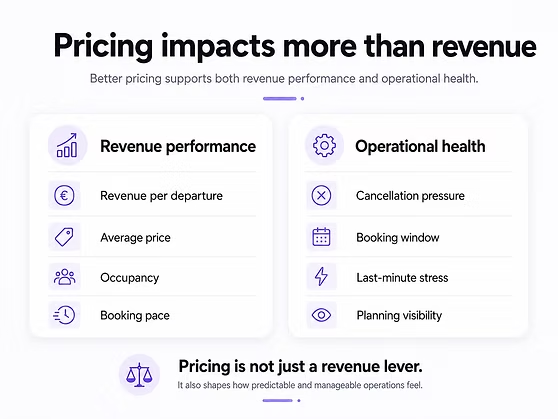
Operational health is the difference between a business that is busy and a business that is running smoothly. It shows up in cancellations, last-minute pressure, booking windows, guide scheduling, availability changes, customer support workload, and how predictable each departure feels.
A tour can generate revenue and still create operational stress. A departure can sell seats and still be difficult to manage. A product can look successful on paper while the team is constantly reacting behind the scenes.
That is why pricing should not only be measured by revenue or occupancy. It should also be measured by whether it supports a healthier, more predictable operation. For tour operators, better pricing is not just about charging the right price. It is also about making the operation easier to run.
Most operators think about cancellations as a customer-service issue. A guest cancels. A seat reopens. The team processes the update and moves on. But cancellations also affect pricing and revenue management.
When pricing better reflects demand, booking timing, and availability, operators can encourage healthier booking behavior, avoid over-relying on last-minute demand, and create a more stable revenue mix. That does not mean pricing alone prevents cancellations, but it can support better operational health by helping the business attract bookings at the right time and at the right price.
When a cancellation happens, the business is not simply back to where it started. The timing matters.
A cancellation 30 days before departure is very different from a cancellation 24 hours before departure. In both cases, the seat is available again, but the opportunity to resell it is not the same.
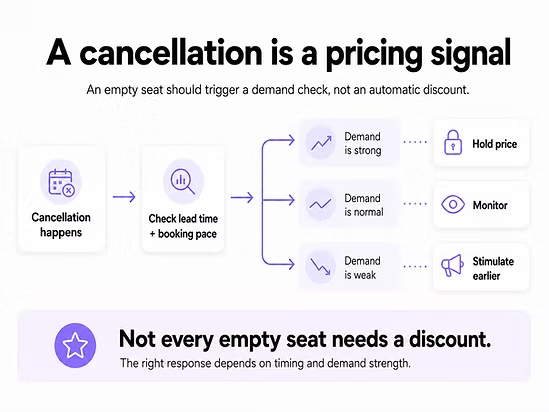
The better question is not simply whether we can fill the seat again. It is what this cancellation means for demand, pricing, and the rest of the booking window. If demand is still strong, the operator may not need to discount. If demand has slowed or the departure is close and booking pace is weak, a different strategy may be needed.
If demand is still strong, the operator may not need to discount.
If demand has slowed, the reopened seat may need a different strategy.
If the departure is close and booking pace is weak, the team may need to act quickly.
This is where dynamic pricing for tour operators becomes valuable. A cancellation should not automatically trigger a discount. It should trigger a reassessment of where demand actually sits. Without a system watching those signals, cancellations often create manual work instead of pricing insight, and prices get adjusted reactively rather than strategically.
Revenue management is not only about how many people book. It is also about when they book.
A business that gets more bookings earlier has more visibility. It can plan guides more confidently, manage vehicle capacity, understand which departures are ahead or behind pace, and avoid relying too heavily on last-minute demand.
Short booking windows create uncertainty. If most bookings arrive close to departure, the operation becomes harder to plan and the team may not know whether a tour is truly underperforming or simply waiting for late demand.
That is why pricing should not only be used to fill seats at the end. It should help shape demand earlier in the booking cycle. If demand is weak, the opportunity is to stimulate interest while customers are still comparing options. If demand is strong, the opportunity is to protect price as availability becomes more limited. Both decisions are easier when operators can see how booking pace compares to expected demand.
We have seen booking windows become healthier when pricing is managed more proactively. Instead of relying heavily on reservations that arrive in the final days before departure, operators can gain more visibility earlier in the cycle. That creates a smoother operation: teams can plan guides, capacity, and availability with more confidence, while feeling less reactive going into each departure.
A reopened seat is not just an empty seat. It is part of a larger demand picture. If cancellations reopen seats and bookings recover, that may suggest demand is still healthy. If they do not recover, that may suggest demand is weaker than expected.
The same cancellation can mean different things depending on timing, lead time, booking pace, and historical behavior. That is why cancellations should not be viewed in isolation. The question is not simply whether the seat is available again. It is whether the market still has enough demand to fill it at the current price.
This is especially important for operators managing multiple departures and channels. A single cancellation may be easy to handle manually. Hundreds of booking changes across products, dates, and resellers are much harder to interpret consistently. That is where automation can support better operational health.
Revenue management is often associated with airlines and hotels. But for tour and activity operators, it has a very practical operational role. It helps operators understand which departures need attention, which ones should hold price, which ones are ahead of pace, and which ones may need support before it is too late.
BCG has also noted that revenue management has expanded beyond airlines, hotels, and rental cars into other businesses with perishable inventory, including tour operators, cruise lines, railways, and event managers. That broader shift matters because tours and activities face the same core challenge: once a departure passes, unsold inventory can no longer be recovered.
As Reserhub notes in its overview of dynamic pricing trends in travel, dynamic pricing is increasingly being used across the travel industry to respond to changing demand, improve revenue performance, and make pricing decisions more adaptive.
Revenue management connects pricing to daily operational questions:
Aloja's approach comes from working closely with tour and activity operators, where pricing decisions are rarely just about numbers. They also affect staffing, planning, customer experience, and how confidently teams can run each departure.
Poor operational health does not always show up as lost revenue. Sometimes it shows up as unnecessary discounts, late decisions, rushed planning, or a team constantly reacting to changes that could have been spotted earlier.
A healthier operation is not just one that sells more. It is one that understands demand earlier, responds more consistently, and gives the team more control over how the business runs.
That is where dynamic pricing becomes more than a revenue tool. It becomes part of how operators build a stronger, more predictable business.
Operational health refers to how predictable, manageable, and efficient the business feels day to day. For tour operators, this includes cancellation rates, booking windows, last-minute demand, guide scheduling, and how consistently the team can respond to demand.
Cancellations matter because they reopen inventory and change the pricing opportunity for a departure. Operators should look at cancellations together with booking pace, lead time, availability, and historical demand before deciding whether to hold, increase, or lower price.
Dynamic pricing helps operators monitor booking pace, cancellations, lead time, and demand patterns more consistently. Instead of relying on manual checks, operators can use demand-driven pricing to identify which departures are ahead of pace, which need support, and which should stay disciplined.
No. Revenue management can help small and mid-sized tour operators too, especially when they manage multiple products, departures, time slots, or sales channels. The more difficult pricing becomes to monitor manually, the more valuable demand-based pricing and automation can become.
No. Dynamic pricing should support operator judgment, not replace it. Operators can still set pricing boundaries, strategy, and rules, while the system monitors demand signals and helps pricing respond more consistently in the background.
What we're seeing across live accounts, and the questions operators keep asking. No product announcements.